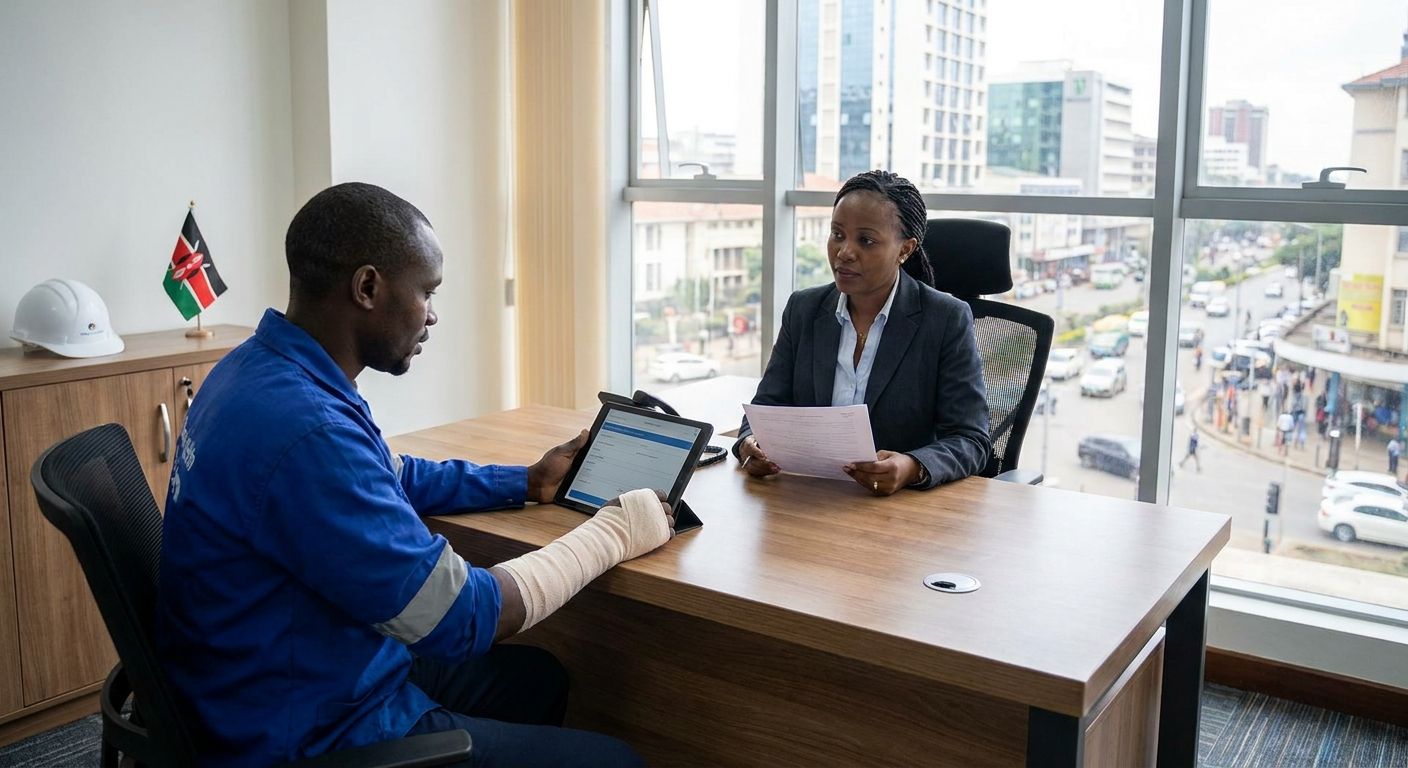
Yes. Under the Work Injury Benefits Act, 2007 (WIBA), an employee injured while doing their job in Kenya can claim compensation from their employer's insurer without having to prove the employer was negligent. The amount isn't a fixed shilling figure — it's calculated against your earnings and the degree of incapacity a medical assessment confirms, and a late claim can cost you the right to any payout at all.
- WIBA, 2007 lets employees claim workplace injury compensation in Kenya without proving employer fault.
- Payout size depends on earnings and assessed degree of incapacity, not a flat amount.
- Claims generally need to be lodged within 12 months of the accident.
- A separate civil negligence suit is possible where the employer's fault is clear and damages could exceed the WIBA schedule.
- An employment advocate can confirm which route fits your specific injury before you sign anything.
Why this matters
Most injured workers in Kenya either don't know WIBA exists or assume a workplace injury means going to court. Neither is true, and both assumptions cost people money.
Some employers settle informally with a cash handout that's far below what the injured worker is owed under the Act. Others simply never had valid insurance cover in place, which changes the whole claim process. Knowing which situation you're in before you accept anything from an employer is the difference between a fair outcome in 2026 and a claim you can't reopen later.
Booking a short session with an LSK-verified advocate through Lex Africa before you sign a discharge form or settlement letter is a cheap way to check whether the number on offer matches what the law actually provides.
Can I get compensation for a workplace injury in Kenya?
Yes, through one of two routes, and they work very differently.
| Route | Fault required? | Who pays | Typical timeline |
|---|---|---|---|
| WIBA claim | No — no-fault scheme | Employer's WIBA insurer | Weeks to a few months once incapacity is assessed |
| Civil negligence suit | Yes — must prove employer breach of duty | Employer or insurer via court judgment | Often well over a year; see how a personal injury claim typically settles in Kenya |
The WIBA route is faster and doesn't need proof of negligence, but it caps compensation to a statutory schedule. A civil suit can pay more, but only if you can prove the employer was at fault, and it takes far longer. Most workers pursue WIBA first and only consider a civil suit when the injury is severe and the employer's negligence is obvious — unsafe machinery, no protective gear, ignored safety warnings.
Temporary disablement
If the injury stops you working for a period but you're expected to recover, WIBA compensation is calculated as a percentage of your earnings for the period you're unable to work, based on a medical report confirming the disablement. You don't need to resign or be dismissed to claim — the claim runs alongside your employment.
Permanent disablement
Where the injury leaves you with a lasting impairment — partial or total — the compensation is assessed against a degree-of-incapacity percentage set by a medical practitioner and applied to a formula tied to your earnings. A finger injury and a spinal injury are not compensated the same way, and the assessment itself is where most disputes arise.
Fatal workplace injuries
When a workplace accident results in death, WIBA allows dependents — typically a spouse and children — to claim compensation instead of the deceased employee. This claim runs separately from, and doesn't require, a civil suit, though dependents can also explore a civil claim if negligence is clear.
Why compensation amounts vary
- Your earnings at the time of the accident — WIBA compensation is a function of salary, so two workers with identical injuries can receive different amounts.
- The degree of incapacity assessed — a medical report classifying the injury as 10% versus 40% incapacity changes the payout substantially.
- Whether the injury is temporary or permanent — permanent disablement claims involve a different calculation than short-term recovery periods.
- Whether the employer actually had WIBA insurance — a cover gap doesn't remove your right to compensation, but it changes who you're chasing and how fast.
- Whether the claim is contested — an employer or insurer disputing the cause of the accident, or the medical assessment, slows everything down.
- Whether you also pursue a civil suit — a successful negligence claim can add compensation beyond the WIBA schedule, but takes longer and costs more to run.
“WIBA doesn't ask who caused the accident — it asks how badly you were hurt and what you were earning.”
What if my employer has no WIBA insurance cover?
You can still claim, because WIBA compensation is a statutory obligation on the employer, not a benefit that only exists if insurance was purchased. If the employer has no valid cover, the claim is pursued directly against the employer rather than an insurer, which usually means slower payment and a real risk of the employer disputing liability harder than an insurer would.
Can I sue my employer directly for a workplace injury in Kenya?
Yes, a civil negligence suit is available alongside or instead of a WIBA claim, but only where you can show the employer breached a duty of care — unsafe equipment, no training, ignored hazard reports. This route can produce a higher award than the WIBA schedule, but it takes considerably longer and the outcome isn't guaranteed the way a WIBA claim is.
How long does a workplace injury claim take to settle in Kenya?
A straightforward WIBA claim with clear medical evidence and an insured employer can move in weeks to a few months once incapacity is assessed. A disputed claim, or one that turns into a civil suit, follows a much longer path — the personal injury claim settlement timeline in Kenya breaks down what typically stretches that process out.
Check your claim before you settle
Book a 15-minute video consultation with an LSK-verified employment advocate.
If your employer has offered a settlement figure or you're unsure whether your case belongs under WIBA or in court, a short session with one of the best employment lawyers in Kenya is enough to confirm whether the number is fair and which route protects you better in 2026.
FAQ
Can I get compensation for a workplace injury in Kenya without a lawyer?
Yes, a WIBA claim can be filed without a lawyer since it's a no-fault statutory process, but disputed medical assessments or a stalled insurer make legal input worth the cost.
How much compensation can I get for a workplace injury in Kenya?
There's no fixed amount — WIBA compensation is calculated against your earnings and the medically assessed degree of incapacity, so the figure differs case by case.
Does WIBA cover injuries that happen outside the workplace?
WIBA covers injuries arising out of and in the course of employment, which can include off-site work travel or duties, but not accidents unrelated to your job.
What happens if my employer denies the accident happened at work?
The claim becomes contested and typically needs medical and witness evidence to support that the injury arose during employment before the insurer or employer will pay.
Can I claim WIBA compensation and still keep my job?
Yes, a WIBA claim runs independently of your employment status — filing one is not grounds for dismissal and you don't need to resign to claim.
Is there a deadline to file a workplace injury claim in Kenya?
Claims generally need to be lodged within 12 months of the accident, and missing that window can affect your right to compensation.
Can dependents claim compensation if a worker dies on the job?
Yes, dependents such as a spouse or children can claim WIBA compensation directly when a workplace accident results in death.
Is a civil lawsuit better than a WIBA claim for a workplace injury?
A civil suit can pay more than the WIBA schedule when negligence is provable, but it takes far longer and carries more uncertainty than a straightforward WIBA claim.
One last thing
The part most injured workers miss is that WIBA compensation and a civil negligence suit are not mutually exclusive in every case — a badly handled WIBA claim isn't your only shot at being compensated fairly for a 2026 workplace accident. Before accepting a settlement figure from an employer, get a second opinion on whether the assessed degree of incapacity actually matches your medical report; that number, not the employer's offer, is what determines what you're owed.