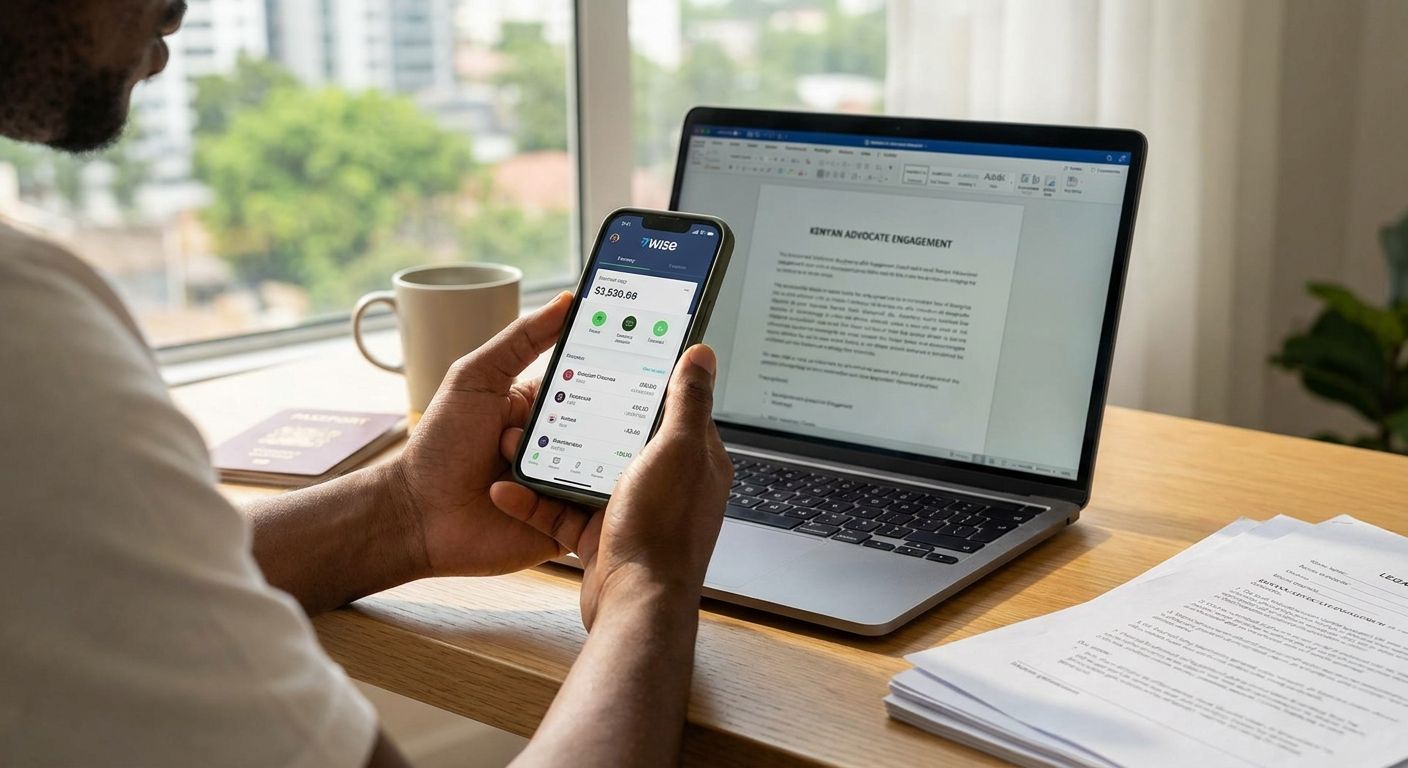
Contract law for freelancers in Kenya is the set of rules under the Law of Contract Act (Cap 23) and ordinary contract principles that decide whether a freelance agreement is enforceable, what a client actually owes you, and what happens when a deal goes sideways. A freelancer's problem looks different from a registered company's: no in-house legal team, clients who treat a WhatsApp confirmation as a binding deal, and disputes where the amount owed is often smaller than the cost of fighting for it in court.
- Contract law for freelancers in Kenya runs on the Law of Contract Act (Cap 23) — a verbal deal is enforceable but nearly impossible to prove.
- Contract claims in Kenya carry a 6-year limitation period under the Limitation of Actions Act (Cap 22) — after that, courts won't hear the case.
- Kenya's Small Claims Court handles disputes up to KES 1 million, which covers most freelance invoice fights.
- Lex Africa connects freelancers with LSK-verified advocates for a 15-minute video review of a contract before it gets signed.
- Scope creep and undefined payment terms cause more freelance disputes in Kenya than outright non-payment.
Why contract law matters for freelancers
Most freelance work in Kenya starts on WhatsApp, email, or a handshake at a networking event, and that habit is exactly where disputes come from. A verbal agreement is legally valid under Kenyan contract law, but proving what was actually agreed — the deliverable, the deadline, the price — becomes a word-against-word argument the moment a client stops replying.
Freelancers also sit outside the protections built into the Employment Act, 2007, because that law covers employees, not independent contractors. There's no statutory notice period, no automatic severance, and no labour officer to call. The only protection a freelancer has is whatever was agreed in the contract itself, which is why the document matters more here than it does for a salaried employee.
Write every agreement down before work starts
A written contract doesn't need to be a 20-page legal document to hold up. It needs to capture the terms clearly enough that a court or arbitrator can reconstruct what both sides agreed to.
- State the client's full legal name and yours, not just first names or company nicknames
- Record the exact deliverable in one sentence — "a 12-page brand guideline PDF," not "branding work"
- Put the price and currency in numbers, not "we'll discuss it"
- Date the agreement and note how it was signed (email confirmation counts)
- Attach the brief or scope document as an annex, not a separate untracked file
Even a confirmation email that says "per our call, I'll deliver X by Y for Z" and gets a "confirmed" reply from the client creates an enforceable record. Do freelancers need signed contracts to get paid in Kenya walks through what counts as sufficient proof when a client disputes an invoice.
Define scope and deliverables with no room for interpretation
Scope creep is the single most common freelance dispute in Kenya, and it's rarely about outright non-payment — it's about a client expecting three rounds of revisions when the contract never mentioned a limit.
- Cap the number of revision rounds explicitly ("two rounds included, additional rounds billed separately")
- List what's excluded, not just what's included — "does not cover video editing" prevents assumption
- Set a deadline for client feedback, since a project can stall waiting on approvals
- Define what happens if the brief changes mid-project (new quote, new timeline)
- Specify file formats and delivery method so "delivered" isn't disputed later
Set payment terms that protect your cash flow
Payment terms decide whether you chase money for months or get paid on schedule. Vague terms like "pay when done" leave too much room for a client to stall.
- Require a deposit before work begins, typically 30-50% of the total
- Set a fixed number of days for final payment after delivery (7 or 14 days is standard)
- Add a late payment clause with a defined penalty or interest rate
- Specify the payment method (bank transfer, M-Pesa, cheque) to avoid excuses about processing delays
- State clearly that final files are withheld until final payment clears
This is where a short review from an advocate earns its cost. A 15-minute video consultation on lex.africa can catch a payment clause that looks fine on paper but has no real enforcement teeth — before the contract is signed, not after the client has already ghosted you.
Add a termination clause that works both ways
Projects end early more often than freelancers plan for — budget cuts, a client pivot, or a freelancer who needs to walk away from a bad-fit engagement.
- State how much notice either side must give to end the contract early
- Specify what's owed for work completed up to the termination date
- Address what happens to a deposit if the client cancels before work starts
- Clarify whether partial deliverables get handed over on early termination
- Note any conditions that allow immediate termination (non-payment, breach of confidentiality)
Protect your intellectual property until you're paid
Under Kenyan copyright principles, the creator generally owns the work until rights are formally transferred — but most freelance contracts assign IP automatically on delivery, which means you can lose leverage before payment clears.
- Add a clause that IP transfers only on receipt of full payment, not on delivery
- Specify whether you can use the work in your own portfolio
- State whether the client gets exclusive rights or a licence to use the work
- Address ownership of source files (design files, code repositories) separately from the final output
Include a dispute resolution clause before you need one
A dispute clause decides where and how a disagreement gets resolved, and it's the clause freelancers skip most often because nobody expects a fight at signing.
- Name the jurisdiction (courts in Kenya) so there's no ambiguity for cross-border clients
- Consider an arbitration clause for higher-value contracts, since is arbitration cheaper than court in Kenya is a real question worth answering before a dispute happens
- Set a mandatory negotiation period before either side goes to court or arbitration
- Reference Kenya's Small Claims Court option for disputes under KES 1 million, since it moves faster than the regular court system
“A contract clause you didn't understand at signing is the clause that costs you the most when the client disappears.”
Know when a lawyer needs to look at the contract
Templates and free clauses cover most freelance deals. High-value contracts, retainer agreements, or anything involving IP assignment or cross-border clients benefit from a professional read before signing.
| Option | Best for | Key limitation |
|---|---|---|
| Free online templates | Small one-off gigs under simple scopes | Generic wording rarely fits Kenyan enforcement rules |
| DIY clauses from past contracts | Freelancers with repeat, similar clients | No protection against clauses that look fine but don't hold up |
| Lex Africa 15-minute video consultation | A quick, focused review before signing a specific contract | Not a substitute for ongoing retained legal counsel |
| Full-service law firm retainer | High-value, recurring, or complex commercial work | Slower turnaround, overkill for a single freelance gig |
Verdict: for a one-off contract worth checking before you sign it, a short advocate consultation through Lex Africa is the fastest path to a professional opinion without committing to a retainer.
Get a contract reviewed before signing
Book a 15-minute video consultation with an LSK-verified advocate.
Common mistakes freelancers make in Kenya
- Relying on WhatsApp confirmations alone. They're evidence, but weak evidence compared to a signed document with clear terms.
- Skipping the deposit. Freelancers who deliver first and invoice after carry all the risk if the client stalls.
- Leaving payment terms vague. "Pay when convenient" isn't a payment term — it's an invitation to delay.
- Assuming IP transfers automatically. Without a clause, ownership disputes over source files and portfolio use get messy fast.
- Ignoring the limitation period. Waiting years to chase an unpaid invoice risks running past the 6-year window under the Limitation of Actions Act (Cap 22) for simple contract claims.
If an unpaid invoice sits below that KES 1 million threshold, how long does a contract dispute take to resolve in Kenya is worth reading before deciding whether to go the Small Claims Court route or negotiate directly.
FAQ
Is a verbal contract enforceable for freelancers in Kenya?
Yes, a verbal agreement is legally valid under Kenyan contract law, but it's difficult to prove what was agreed once a dispute starts. A written record, even a confirmed email, protects you far better in 2026.
Do freelancers in Kenya need a lawyer to draft a contract?
Not for most simple gigs — a clear written agreement covering scope, price, and payment terms is usually enough. A short advocate review makes sense for high-value, recurring, or IP-heavy contracts.
What happens if a client doesn't pay a freelancer in Kenya?
You can send a formal demand letter first, then pursue the claim through Kenya's Small Claims Court if it's under KES 1 million, or through the regular courts for larger amounts.
How long do I have to sue for an unpaid freelance invoice in Kenya?
Simple contract claims generally have a 6-year limitation period under the Limitation of Actions Act (Cap 22). Waiting past that window usually bars the claim.
Can a freelancer keep the rights to their work if the client hasn't paid?
Only if the contract says so explicitly. Most freelance agreements transfer intellectual property on delivery, so add a clause that ties IP transfer to full payment.
Is arbitration better than court for a freelance contract dispute in Kenya?
Arbitration is often faster and more private than court for higher-value freelance contracts, but it requires an arbitration clause agreed to upfront. Court is the default when no such clause exists.
What should a freelance contract in Kenya always include?
Scope of work, price and payment schedule, deadline, IP ownership terms, and a termination clause. Missing any one of these is where most freelance disputes in Kenya start.
One last thing
The clause freelancers skip most often isn't payment or scope — it's the one specifying what happens to partially completed work if a project ends early. Without it, a freelancer who's delivered 70% of a project on a terminated contract has no contractual claim to payment for that portion, only whatever a court decides is fair after the fact. Add it before you send the next contract out, not after a client walks away mid-project.