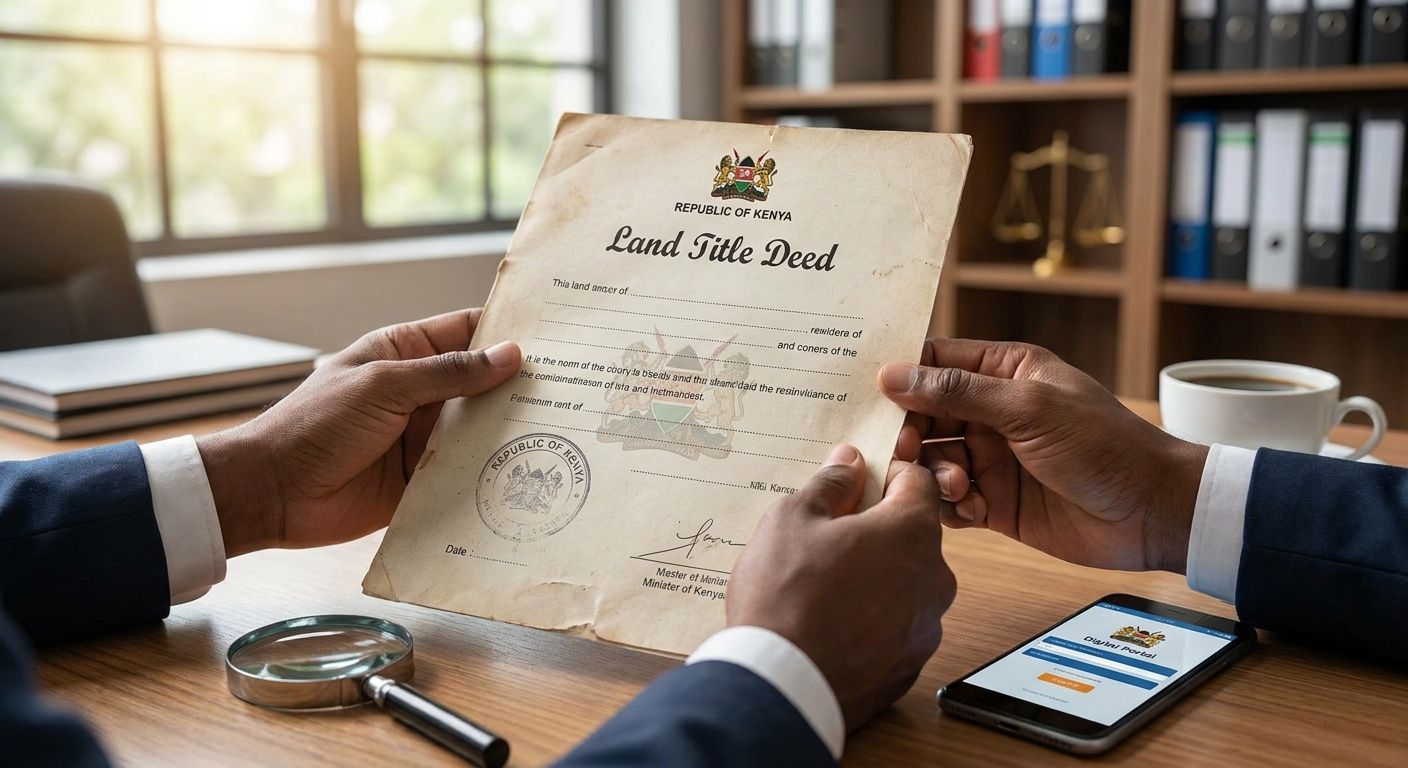
Verifying a title deed in Kenya means running an official search at the relevant Land Registry, or through the Ardhisasa portal for Nairobi and other digitized counties, then confirming the registered proprietor's name, parcel number and any encumbrances match what the seller is telling you. A genuine deed on its own proves nothing — fraudsters forge stamps and signatures convincingly, so the search result from the registry, not the paper in your hand, is what actually confirms ownership.
- Verify a title deed is genuine in Kenya by running an official search at the Land Registry or Ardhisasa, not by inspecting the paper.
- A search confirms today's register entry only — it does not clear fraud that happened earlier in the chain of title.
- Missing spousal consent, Land Control Board consent, or a live caution are the most common reasons a 'clean' deed still fails.
- Physical site verification against the survey plan matters as much as the paper search in 2026.
Why this matters
Land fraud in Kenya rarely looks obvious. The deed can carry a real Ministry of Lands stamp, the seller can produce an ID that matches the name on the document, and the parcel can still belong to someone else, be under a family dispute, or carry a bank charge nobody mentioned. A property lawyer in Kenya runs the same three checks every time — register search, physical inspection, consent confirmation — because any one of them missed is how buyers lose money. The steps below are the general due-diligence process; they don't replace a lawyer's review of your specific transaction.
How do you verify a title deed is genuine in Kenya?
- Get the parcel or LR number from the deed and confirm it matches the seller's ID and any sale agreement already signed.
- Run an official search at the relevant Land Registry, or via Ardhisasa if the county is digitized, to see the current registered proprietor, size, and any encumbrances.
- Check for cautions, restrictions or charges on the search result — a bank charge or a caution filed by a third party means the land isn't free to sell.
- Visit the land physically and confirm the beacons match the survey plan attached to the deed — deeds sometimes describe land that doesn't match what's on the ground.
- Confirm spousal consent where the seller is married, since a disposition of matrimonial property without consent from the spouse can be challenged later.
- Confirm Land Control Board consent if the parcel is agricultural land, which the Land Control Act requires before a valid transfer.
- Cross-check the seller's identity documents against the name on the register — a common fraud pattern uses a fake ID matching a stolen or forged deed.
Verifying a title deed in Nairobi and other Ardhisasa counties
Counties migrated to the Ardhisasa digital land registry — Nairobi first, with others added since the rollout began — let you run an official search online and get a downloadable search certificate tied to the parcel number. The system also flags active transactions, pending transfers, and registered charges in real time, which cuts the window for a fraudster to sell the same parcel to two buyers simultaneously. Ardhisasa doesn't remove the need to visit the land or confirm spousal consent; it only speeds up the registry-side confirmation.
Verifying a title deed in counties still on manual land registries
Counties that haven't migrated to Ardhisasa still require a physical search at the local Land Registry office, submitted on the prescribed form with the parcel details. Manual registries move slower and depend on paper records that are more vulnerable to tampering, missing files, or clerical errors than a digital system. Buyers in these counties lean more heavily on physical site verification and a lawyer's registry visit, since there's no instant online cross-check against duplicate transactions.
“A search certificate proves what's on the register today, not what happened to the land before this owner.”
Why title deed fraud happens in Kenya
- Double allocation — the same parcel gets sold to two or more buyers before the register catches up, especially common in fast-selling peri-urban areas.
- Forged stamps and signatures — a deed can look official and still be a complete fabrication, since paper documents alone aren't verifiable.
- Missing spousal consent — a sale completed without the required consent from a spouse can be contested and unwound after money has changed hands.
- Succession not finalized — land still registered to a deceased relative gets sold by someone without full legal authority to transfer it.
- Fake or expired power of attorney — a seller acting for an absent owner (common with diaspora-owned land) using a POA that's forged or no longer valid.
- Uncleared charges or cautions — a bank charge, court caution, or dispute registered against the parcel that the seller doesn't disclose upfront.
A registry search catches most of these on paper. It won't catch a forged POA or a succession issue that hasn't been flagged yet, which is why an advocate handling property due diligence checks the ownership chain, not just the current entry.
Verify before you pay
Get a 15-minute video consult with an LSK-verified property advocate before you commit funds.
Can a title deed be fake even if it has a government stamp?
Yes — a title deed can carry a convincing stamp and signature and still be fraudulent, which is exactly why the register search matters more than the physical document. Fraudsters replicate Ministry of Lands stamps closely enough that visual inspection alone won't catch a forgery in 2026.
What documents should I ask the seller for before paying anything?
Ask for the original title deed, a recent search certificate, the seller's ID, and spousal consent documentation if the seller is married, before any deposit changes hands. If the parcel is agricultural land, also request evidence of Land Control Board consent, since a transfer without it can be void.
Can foreigners or diaspora buyers verify land the same way?
Yes, the same search and consent process applies to diaspora buyers, though verifying land from abroad usually means appointing someone locally to handle the physical inspection and registry visit. Buyers based outside Kenya should also check the specific rules on foreign land ownership in Kenya before signing anything, since leasehold and freehold rules differ for non-citizens.
FAQ
How do I verify a title deed is genuine in Kenya?
You verify a title deed by running an official search at the Land Registry or Ardhisasa portal to confirm the registered proprietor, parcel size, and any encumbrances match the deed presented to you. Physical inspection of the land and confirmation of spousal or Land Control Board consent, where required, complete the check.
What does a land search actually show?
A land search shows the current registered proprietor's name, the parcel or LR number, the land size, and any charges, cautions or restrictions active against the title. It reflects the register as it stands on the day of the search, not the full history of the parcel.
Is Ardhisasa available in every county in Kenya?
No, Ardhisasa covers Nairobi and a growing list of digitized counties, but several counties still run manual land registries as of 2026. Check with the relevant county registry if you're unsure whether digital search is available.
Can I do a land search myself without a lawyer?
Yes, land searches can be done directly by the buyer, either online through Ardhisasa or in person at a manual registry. Interpreting the results correctly — spotting a caution, an unresolved succession issue, or a missing consent — is where a property lawyer adds value beyond the search itself.
What happens if I buy land with a fake title deed?
Buying land with a fake title deed means you don't acquire valid ownership even after paying, and recovering your money from the seller can take a lengthy court process. This is why the registry search happens before payment, not after.
Does a title deed guarantee the land is free of disputes?
No, a title deed alone doesn't guarantee the land is dispute-free, since disputes can exist that haven't yet been recorded as a caution on the register. Physical inspection and asking neighbors or local administration about the parcel's history adds a layer the paper search won't show.
Do I need spousal consent to buy land from a married seller?
You need confirmation that the seller's spouse consented to the sale if the land qualifies as matrimonial property, since a sale without that consent can be challenged later. This applies even when only one spouse's name appears on the title deed.
One last thing
The search certificate you get back from the registry is only as current as the day it was issued — a clean search today doesn't stay valid if a charge or caution gets filed the following week, so buyers who take weeks to close should run the search again just before transfer. Land disputes that surface after a sale, whether over succession, boundaries, or a rival buyer, usually cost far more to unwind than the search would have cost to catch upfront.