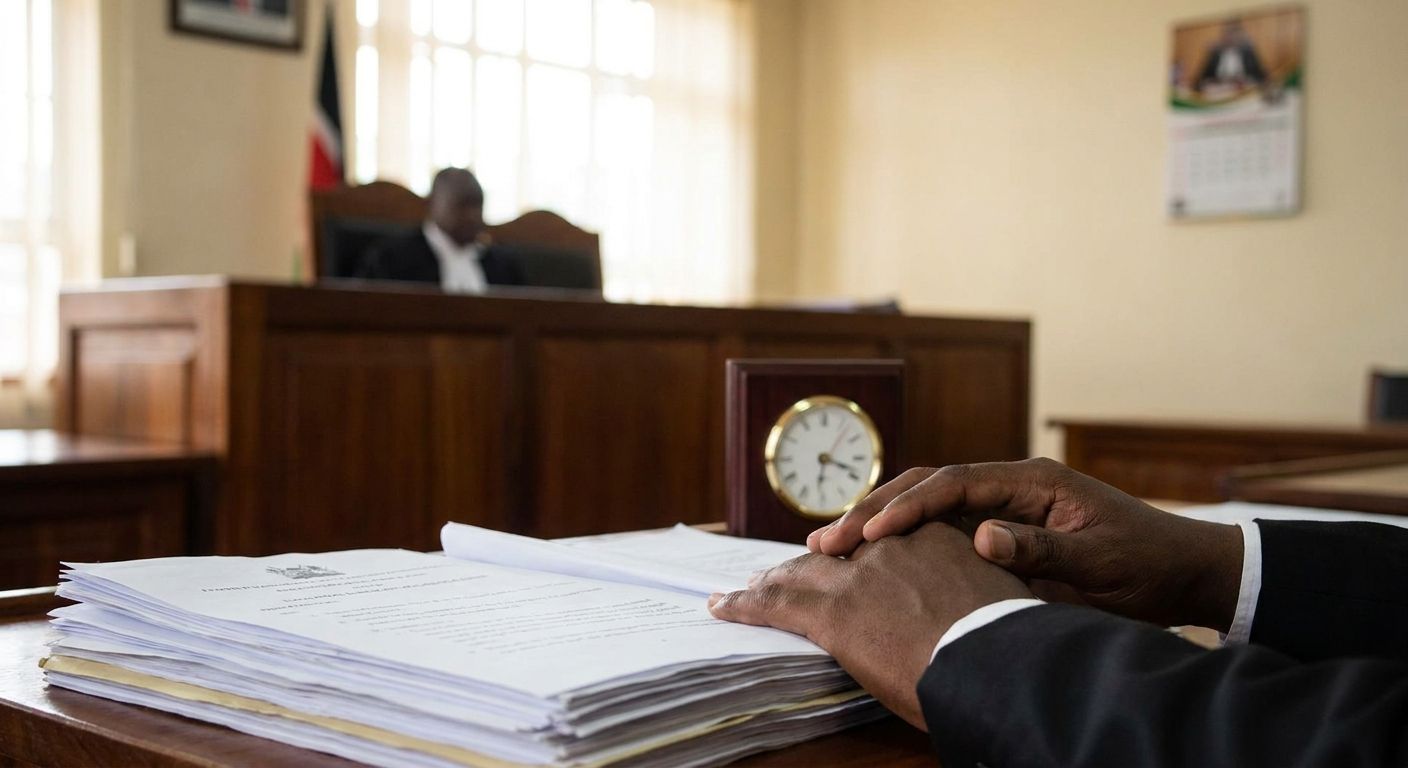
A small claims case in Kenya is decided within 60 days of filing, under Section 27 of the Small Claims Court Act, 2016 — but that clock starts on the filing date, not the day the other party actually gets served. An uncontested claim with quick service can close inside two months in 2026; a contested one with a missing defendant or a requested adjournment routinely runs past that statutory window. The Small Claims Court exists to move faster than the Magistrate's Court, and its jurisdiction stops at KES 1,000,000. Anything above that cap, or any matter needing detailed legal argument, belongs in a Magistrate's Court or the High Court instead.
- Kenya's Small Claims Court must determine a case within 60 days of filing, under the Small Claims Court Act, 2016.
- The 60-day clock runs from filing, not from the date the defendant is served — slow service eats into the window.
- Claims are capped at KES 1,000,000; anything higher moves to a Magistrate's Court or the High Court.
- Appeals to the High Court must be filed within 30 days and are limited to a point of law.
- An LSK-verified advocate on Lex Africa can review your claim in a 15-minute video consultation before you file.
Why this matters
Most people filing a small claim in Kenya in 2026 are chasing an unpaid invoice, a deposit that was never returned, or a supplier who didn't deliver. The whole point of the Small Claims Court is speed — you don't need an advocate to stand up and argue your case, and the process is built around forms rather than pleadings.
That speed only holds if you get the basics right at filing: the correct defendant, a valid address, and a claim that actually sits inside the Small Claims Court's jurisdiction. Get any of those wrong and the 60-day target becomes irrelevant, because the case stalls before it's even served.
How long does a small claims case take in Kenya?
Here's the process in order, from filing to judgment:
- File the claim — submit a statement of claim at the Small Claims Court registry nearest to where the dispute arose or the defendant resides.
- Service — the registry serves the defendant with a summons and fixes the first hearing date. This step is where most delay happens.
- Response and first appearance — the defendant is expected to appear and respond; failure to appear can lead to judgment in the claimant's favour.
- Hearing — an adjudicator, not a magistrate, hears both sides. Parties generally present their own evidence without an advocate arguing on their behalf.
- Judgment — the adjudicator issues a decision, targeted to fall within the 60-day window that started at filing.
- Enforcement or appeal — the winning party can move to enforce the judgment; the losing party has 30 days to appeal to the High Court, but only on a point of law.
Each of those first five steps is meant to happen quickly. There's no separate discovery phase or lengthy pre-trial process like you'd see in a Magistrate's Court civil suit — that's the entire design advantage of a small claims case in Kenya.
Debt and contract claims move through the fastest
Straightforward money claims — unpaid invoices, undelivered goods, a bounced cheque — tend to fit the 60-day model best because there's usually one clear document (an invoice, a receipt, a signed agreement) that settles the facts. Disputes that hinge on conflicting accounts of what was agreed verbally take longer, simply because the adjudicator has more to weigh at the hearing.
Why the timeline varies
The 60-day figure is a statutory target, not a guarantee. What actually pushes a case longer or shorter:
- How fast the defendant is served — service delays are the single biggest reason cases run past 60 days, because the clock doesn't pause for them.
- Whether the defendant appears at the first hearing — a no-show can speed things up (judgment by default); a request to adjourn slows things down.
- Whether the facts are contested — a claim resting on one clear document resolves faster than one needing witness testimony from both sides.
- Jurisdictional challenges — if the defendant argues the claim exceeds KES 1,000,000 or belongs in a different court, that dispute has to be resolved first.
- Registry backlog at that specific court station — case volume varies by location, and a busier registry means a longer wait for the first hearing date.
- An appeal — if either side appeals within the 30-day window, the case moves to the High Court and the 60-day figure no longer applies.
Most of what determines speed happens before the first hearing, not during it. Getting the defendant's correct details and a properly drafted claim on record from day one matters more than anything that happens in the hearing room.
Check your claim before you file
Talk to an LSK-verified advocate in a 15-minute video consultation.
What is the maximum amount you can claim in Kenya's Small Claims Court?
KES 1,000,000 is the ceiling for a claim in Kenya's Small Claims Court. Anything above that amount has to go through a Magistrate's Court or the High Court, which follow the slower civil procedure rules rather than the 60-day target.
If your dispute is a debt recovery matter that sits near or over that cap, it's worth checking with an advocate which court actually has jurisdiction before you file — filing in the wrong forum wastes the time you were trying to save. Lex Africa's directory of debt recovery lawyers in Kenya covers advocates who handle exactly this kind of jurisdiction question.
Can I use a lawyer in Kenya's Small Claims Court?
Parties in Kenya's Small Claims Court generally represent themselves at the hearing rather than through an advocate arguing on their behalf — that's part of why the forum is faster and cheaper than a full civil suit. You can still consult an advocate beforehand to check whether your claim is properly framed, whether the amount and defendant are correct, and what evidence to bring.
How does a small claims timeline compare to a full contract dispute in Kenya?
A small claims case targets 60 days from filing to judgment, while a full contract dispute resolved through the regular courts has no comparable statutory cap and can run considerably longer once pleadings, discovery and multiple hearings are factored in. The trade-off for that speed is the KES 1,000,000 jurisdictional limit — claims above that amount don't have the option of the faster track.
FAQ
How long does a small claims case take in Kenya in 2026?
A small claims case in Kenya is meant to take up to 60 days from filing to judgment under the Small Claims Court Act, 2016. Cases with quick service and no adjournments often finish inside that window in 2026; contested claims can run past it.
What is the maximum claim amount in Kenya's Small Claims Court?
KES 1,000,000 is the ceiling for a claim in Kenya's Small Claims Court. Anything above that amount goes to a Magistrate's Court or the High Court instead.
Can I hire an advocate for a small claims case in Kenya?
Parties in Kenya's Small Claims Court generally represent themselves rather than through an advocate at the hearing. You can still consult an advocate beforehand to check your claim and evidence.
How do I appeal a small claims court decision in Kenya?
You have 30 days from judgment to appeal a Small Claims Court decision to the High Court in Kenya. The appeal is limited to a point of law, not a fresh review of the facts.
Is small claims court faster than a magistrate's court in Kenya?
Yes, the Small Claims Court runs on a 60-day statutory determination target, against no fixed timeline for a regular Magistrate's Court civil suit. The trade-off is the KES 1,000,000 claim cap.
What kind of disputes go to small claims court in Kenya?
Small Claims Court in Kenya typically handles debt recovery, unpaid invoices, contract disputes and consumer claims under KES 1,000,000. Land title and matrimonial property disputes go to other courts.
Does the 60-day clock start when I file or when the defendant is served?
The 60-day clock in Kenya's Small Claims Court runs from the date of filing, not the date of service. Slow service on the defendant eats into that window rather than extending it.
One last thing
The 60-day rule has no automatic penalty attached if it's missed — a case that drags on for months isn't dismissed just because the statute set a target. What actually decides whether your small claims case in Kenya stays close to 60 days is almost entirely front-loaded: correct defendant details, a valid address for service, and a claim that's clearly inside the KES 1,000,000 cap before you file in 2026. Get an advocate to check those three things and the rest of the process usually takes care of itself.