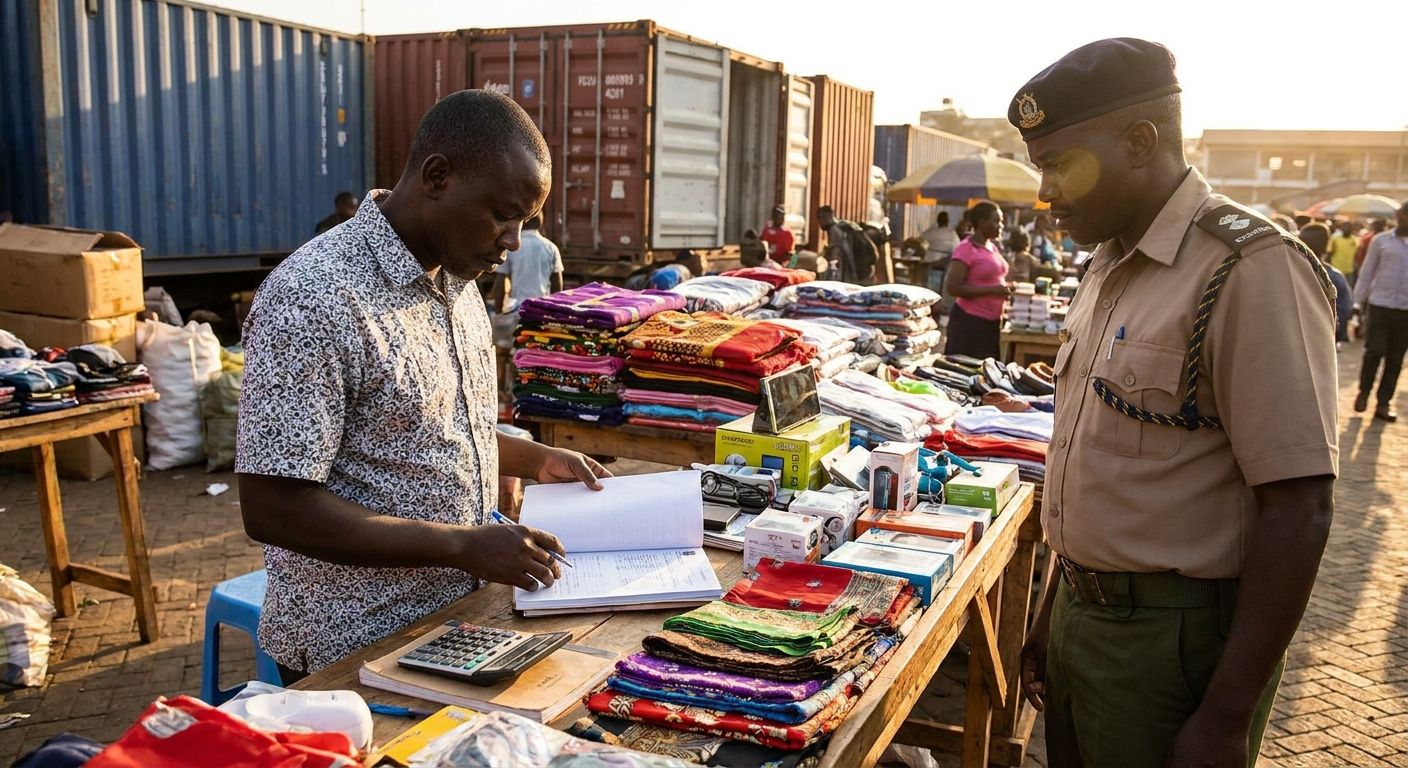
Small traders bringing goods into Kenya face four separate charges on every shipment, and the total tax load lands around 50% of the customs value for most finished consumer goods, ranging from roughly 20% for duty-free raw materials to 60% for goods in the highest protected tariff band. The number that trips up most first-time importers isn't the duty rate itself — it's excise duty, a separate charge that stacks on top of these four charges for specific goods like phones, cosmetics, and alcohol.
- Small traders in Kenya pay import duty at 0%, 10%, 25%, or 35% of customs value depending on the tariff band, in 2026.
- VAT (16%), the Import Declaration Fee (2.5%), and the Railway Development Levy (2%) stack on top of duty, pushing most finished-goods shipments close to a 50% total tax load.
- Goods from EAC or COMESA partner states can clear duty-free under the Simplified Trade Regime if the consignment is worth USD 2,000 or less.
- Excise duty applies separately to specific goods like phones, cosmetics, and alcohol and is never included in the standard duty bands.
Why this matters
Import duty isn't a flat fee. It's calculated on the customs value of your goods — cost, insurance, and freight (CIF) — and then three more charges stack on top before you can collect your shipment. A trader bringing in phone accessories from China pays a very different total than one importing raw materials for manufacturing, even at the same dollar value.
Getting the tariff classification (HS code) wrong is the single biggest reason small traders end up disputing a KRA tax audit months after clearing goods. Lex Africa connects traders with LSK-verified advocates for short consultations on exactly this kind of assessment dispute, before a wrong classification turns into a bigger bill.
How much import duty do small traders pay in Kenya?
Every shipment into Kenya carries four charges, calculated in this order:
| Charge | Rate | Calculated on |
|---|---|---|
| Import duty | 0%, 10%, 25%, or 35% | CIF value, by tariff band |
| Import Declaration Fee (IDF) | 2.5% (minimum KES 5,000) | CIF value |
| Railway Development Levy (RDL) | 2% | CIF value |
| VAT | 16% | CIF value + duty + IDF + RDL |
Here's what that looks like on a KES 300,000 shipment of finished consumer goods sitting in the 25% duty band: duty comes to KES 75,000, IDF to KES 7,500, RDL to KES 6,000, and VAT is charged at 16% on the running total of all four figures — roughly KES 62,160. Add it up and the combined charges reach about KES 150,660, just over 50% of the original shipment value.
Drop the same shipment into the 10% band and total charges fall to around 33% of value. Goods that qualify for the 0% band still carry IDF, RDL, and VAT, landing near 21%. The duty band is the single biggest lever on your final bill.
Raw materials and essential inputs: 0% import duty
Goods classified as raw materials or essential production inputs under the EAC Common External Tariff carry no import duty at all. IDF, RDL, and VAT still apply, so the effective tax load still lands near 20% of value — not zero.
Intermediate and semi-finished goods: 10% import duty
Semi-processed inputs and intermediate goods sit in the 10% band. This tier covers many components small manufacturers and assemblers bring in, and combined with the other three charges the total tax load runs close to a third of the shipment's value.
Finished consumer goods: 25% import duty
Most retail-ready goods small traders import — clothing, household items, electronics accessories — fall into the 25% band. This is where the roughly 50% combined tax figure applies most consistently, and it's the band most small traders in Kenya actually deal with in 2026.
Sensitive and protected goods: 35% import duty
Goods the EAC has flagged as needing tariff protection (certain agricultural products and select manufactured goods) sit in the top 35% band. Combined with IDF, RDL, and VAT, total charges here can reach 60% or more of the shipment's customs value.
Why the duty rate varies
- HS code classification — the tariff heading assigned to your goods determines the band, and a misclassification by a few digits can double your bill.
- Country of origin — goods genuinely originating in EAC or COMESA partner states can qualify for preferential or duty-free treatment; goods merely transiting through a partner state from outside the bloc do not.
- Shipment value against the USD 2,000 threshold — cross the Simplified Trade Regime cap and the full duty, IDF, RDL, and VAT stack applies instead of the simplified exemption.
- Whether the product attracts excise duty — phones, cosmetics, alcohol, and a handful of other categories carry an additional charge layered on top of the standard four.
- Use of a licensed clearing agent — self-declaration is possible for small parcels through postal or courier channels, but commercial and containerized cargo generally require an agent, which adds a service cost outside the tax figures above.
- Exchange rate on the day of clearance — CIF value is converted to Kenya shillings at the prevailing rate KRA applies, so the same dollar invoice can produce a slightly different shilling bill week to week.
Get a second opinion on a KRA assessment
15-minute video consultations with LSK-verified advocates.
Do small traders pay duty on goods from Uganda or Tanzania?
Goods that genuinely originate in Uganda, Tanzania, or another EAC partner state move duty-free within the bloc once they meet the EAC rules of origin. Goods that merely pass through a partner state after being manufactured outside the EAC still attract full duty at the applicable band when they enter Kenya.
What is the Simplified Trade Regime for cross-border traders?
The Simplified Trade Regime (STR) lets small-scale traders at gazetted border posts — including Busia, Malaba, and Namanga — clear goods originating in COMESA or EAC partner states duty-free when the consignment is valued at USD 2,000 or below. Traders use a simplified certificate of origin instead of a full customs declaration, which cuts both the paperwork and the wait at the border.
“If your shipment is worth more than USD 2,000, the Simplified Trade Regime doesn't apply and the full duty, IDF, RDL, and VAT stack applies instead.”
Do I need a clearing agent to import as a small trader in Kenya?
You need a licensed clearing agent for most containerized or commercial cargo, since KRA requires full customs declarations to be filed through the agent system. Small parcels cleared through postal or courier channels can sometimes self-declare, but any dispute over classification or valuation is where a short legal consultation pays for itself before you pay or appeal an assessment.
FAQ
How much import duty do small traders pay in Kenya in 2026?
Small traders in Kenya pay a combined tax load of roughly 20% to 60% of customs value in 2026, depending on the tariff band, with most finished consumer goods landing near 50% once duty, IDF, RDL, and VAT are all added together.
What is the Import Declaration Fee in Kenya?
The Import Declaration Fee (IDF) is 2.5% of the CIF value of a shipment, subject to a minimum of KES 5,000, charged on every import regardless of the duty band.
Is VAT charged on top of import duty in Kenya?
Yes, VAT of 16% is charged on the CIF value plus duty, IDF, and RDL combined, not just on the original goods value, which is why the effective VAT bite is larger than 16% of the invoice price.
Do small traders pay excise duty on imports?
Excise duty applies only to specific goods such as phones, cosmetics, and alcohol, and it is charged in addition to duty, IDF, RDL, and VAT rather than replacing any of them.
What is the Simplified Trade Regime threshold in Kenya?
The Simplified Trade Regime allows duty-free clearance for consignments worth USD 2,000 or less that genuinely originate in an EAC or COMESA partner state, using a simplified certificate of origin at gazetted border posts.
Can small traders clear goods without a clearing agent?
Small parcels through postal or courier channels can sometimes be self-declared, but most containerized or commercial cargo requires a licensed clearing agent to file the customs declaration.
What happens if KRA reclassifies my goods into a higher duty band?
KRA can reissue an assessment at a higher tariff band if it disagrees with your declared HS code, and you can dispute that reclassification before paying if you believe the classification is wrong.
One last thing
The Simplified Trade Regime's USD 2,000 threshold has stayed fixed since it was introduced under the COMESA/EAC framework, and traders who split one large shipment into several smaller consignments to stay under it risk having KRA treat the whole lot as a single commercial import — which wipes out the exemption entirely and applies full duty, IDF, RDL, and VAT retroactively. If a border officer or KRA station flags your consignment for that reason in 2026, get the assessment reviewed before you pay it.